
Week-In-Review: Stocks End Week Mixed As Trade Woes Divide Wall Street
Stocks End Week Mixed As Trade Woes Divide Wall Street

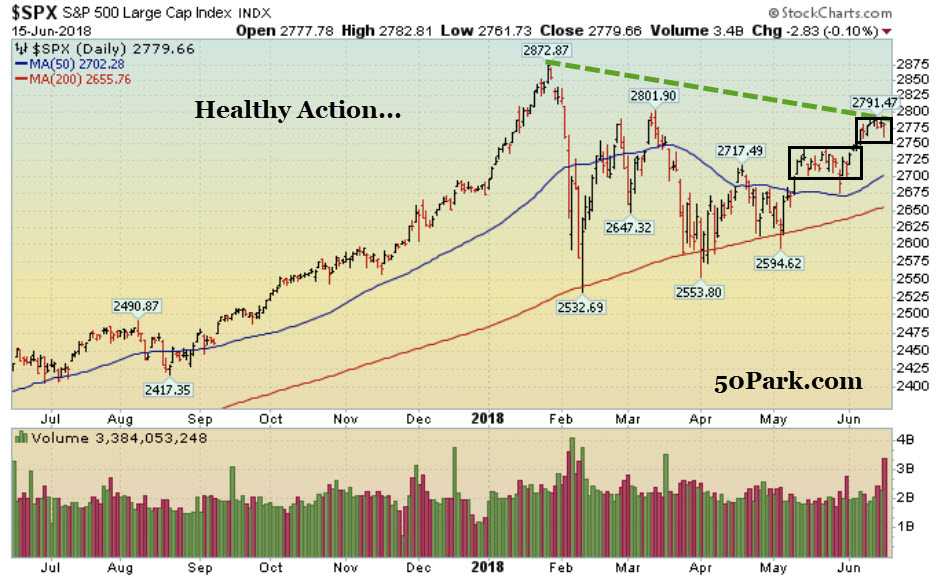
The split tape I mentioned over the last few weeks continues as the Nasdaq and Small-Cap Russell 2000 hit fresh record highs while the S&P 500 and Dow Jones Industrial Average lag. The reason is simple: there remains a lot of uncertainty with respect to how this ongoing “trade war” that is brewing may unfold. The Dow and S&P 500 are more sensitive to these headlines while the Nasdaq and the R2k are less sensitive. Elsewhere, it was a big week for global central banks as they are all (slowly) moving away from the ultra-easy money era since the 2008 financial crisis. To be clear, they are still adopting an easy money stance, but the ultra-easy money period is now behind us (at least until the next recession or bear market).

Mon-Wed Action:

Stocks ended slightly higher on Monday after the G-7 meeting ended and Trump headed to Singapore for the N. Korea Summit. Overnight, Trump and Kim signed a historic deal and the market barely moved. On Tuesday stocks were quiet as the world waited for a busy week from global Central Banks. Separately, Tesla said it will slash 9% of its workforce and Elon Musk acknowledged that the company will have to turn a profit “some day.” Stocks fell on Wednesday after the Federal Reserve raised rates and signaled two more rate hikes may happen later this year.

Thur & Fri Action:

Stocks ended mixed on Thursday after the ECB slowly moved away from its ultra-easy money stance and President Trump signaled he may slap tariffs on China. By Friday’s open, $50 billion of tariffs were announced and now the world is waiting for China to respond. That concern largely dragged the market lower on Friday.

Market Outlook: Bullish Action

The small-cap Russell 2000 and Nasdaq both hit new highs which is bullish for the broader market. The other indices are acting well and still trading between important resistance (2018’s high) and important support (February’s low). Until either level is broken, I have to expect this sloppy, sideways action to continue. On the downside, the big level of support to watch is the 200 DMA line and then February’s low. For now, as long as those levels hold, the longer-term uptrend remains intact. Conversely, if those levels break, look out below.  As always, keep your losses small and never argue with the tape. Free Special Report: Want A Bargain? 3 Cheap Stocks That Are About To Breakout

Similar Posts

  • U.S. Stocks; Forming A New Base

    Mortgage Apps Fall & Produce Price Index Jumps!
    Before Wednesday’s open, the Mortgage Bankers Association (MBA) said mortgage applications slid by a disturbingly large -9.1%. The report blamed tepid economic conditions and a volatile stock market for the two primary reasons behind the large decline. Separately, the Labor Department said its produce price index (PPI) rose +0.2% despite lower energy prices. Core prices, which exclude food and energy, rose +0.4% which was the largest increase since January and rose +0.3% in June. Since the March 2009 bottom, inflation has remained largely at bay which has helped alleviate pressure on the Federal Reserve to raise rates. However, if inflation swells over the next few quarters than the Fed may be put in a precarious situation; raise rates to curb inflation or leave rates low to stimulate the stale economy?

  • Stocks Negatively Reverse From Resistance

    Thursday, July 29, 2010 Stock Market Commentary: The major averages negatively reversed after encountering resistance near their prior chart highs. Volume, an important indicator of institutional sponsorship, was higher than Wednesday’s session which marked a distribution day for the NYSE and the Nasdaq exchange. Advancers led decliners by a 20-to-17 ratio on the NYSE and were about even on…

  • 2nd Quarter & QE2 End, Finally!

    Market Outlook- Market In A Correction:
    The market is back in a correction after another failed follow-through day on Tuesday, June 21, 2011. Now that we are back in a correction, defense remains the best offense. The next level of support for the major averages is their respective 200 DMA lines and then their March lows. The next level of resistance for the major averages is their respective 50 DMA lines. Trade accordingly.
    For those of you that are interested, the S&P 500 hit a new 2011 high on May 2, 2011. Two days later, on Wednesday, May 4, 2011, we turned cautious and said “The Rally Was Under Pressure” (read here). Then on Monday, 5.23.11, we changed our outlook to “Market In A Correction” (read here). On Monday, June 6, 2011 we pointed out that the S&P 500 violated its 9-month upward trendline (read here) and reiterated our cautious stance. On June 21, 2011 we changed our Market Outlook to a “Confirmed Rally” after the latest FTD was produced. Two days later, on Thursday, June 23, 2011, our outlook changed to “Market In A Correction”after the market sold off hard on renewed economic woes. If you are looking for specific help navigating this market, please contact us for more information.
    Stock Market Research?
    Global Macro Research?
    Want To Follow Trends?
    Learn How We Can Help You!

  • New! Bin Laden's Toast; Stocks Fall

    Market Outlook- Market In A Confirmed Rally
    From our point of view, the market is back in “rally-mode” as all the major averages continue to trade above their respective 50 DMA lines and are flirting with, or at, fresh 2011 highs! In addition, leading stocks have held up very well even as the major averages slid below their respective 50 DMA lines in mid-April which is another encouraging sign. If you are looking for specific help navigating this market, please contact us for more information.

  • Stocks Rally As EU Debt Woes Ease

    Looking forward, the window is now open for disciplined investors to begin carefully buying high-ranked stocks again. It was encouraging to see a flurry of high-ranked leaders trigger fresh technical buy signals and break out of sound bases in recent sessions. The next important level to watch for the major averages are their respective 200-day moving average (DMA) lines. It is important to note that approximately 75% of FTDs lead to new sustained rallies, while 25% fail. In addition, every major rally in market history has begun with a FTD, but not every FTD leads to a new rally. Trade accordingly.

Leave a Reply

Your email address will not be published. Required fields are marked *